
“In our culture, we often think of ‘will’ in terms of willpower—gritting our teeth to do something difficult or pushing ourselves to achieve a goal. But in the Montessori approach, the will is something far more profound. We understand that, rather than being about discipline or determination, the will is the very force that propels children forward in life, guiding them from unconscious action to conscious choice.”
— Dr. Maria Montessori
At Maravilla Montessori, supporting the development of the will is a cornerstone of our daily work with children. It is through this natural developmental process that children become truly independent, capable of acting thoughtfully, responsibly, and with authentic purpose.
What Is the Will?
Dr. Montessori described the will as a universal life force. Like memory or language, it is an integral part of human cognitive development—something we are born with that must be carefully nurtured. It is not manufactured by adults; it is cultivated through meaningful activity. And much like our physical muscles, the will grows stronger through repeated, intentional practice.
From birth, children are driven by natural instincts and unconscious developmental urges. Around age four or four and a half, those purely internal motivators begin to shift. That is when the will begins to take over as the child’s primary internal guide. At this stage, children start to act not merely out of impulse, but from conscious, deliberate decision-making.
The Four Stages of Will Development
Montessori outlined four distinct stages in how the will unfolds:
- Instinctual Behaviors: The unconscious reflexes of infancy, such as grasping, crying, and rooting. These are essential for physical survival.
- Deliberate Actions: Soon, babies begin to act with intent. We see this as they turn their head toward a parent’s voice or reach for an object. These actions demonstrate a developing awareness of cause and effect.
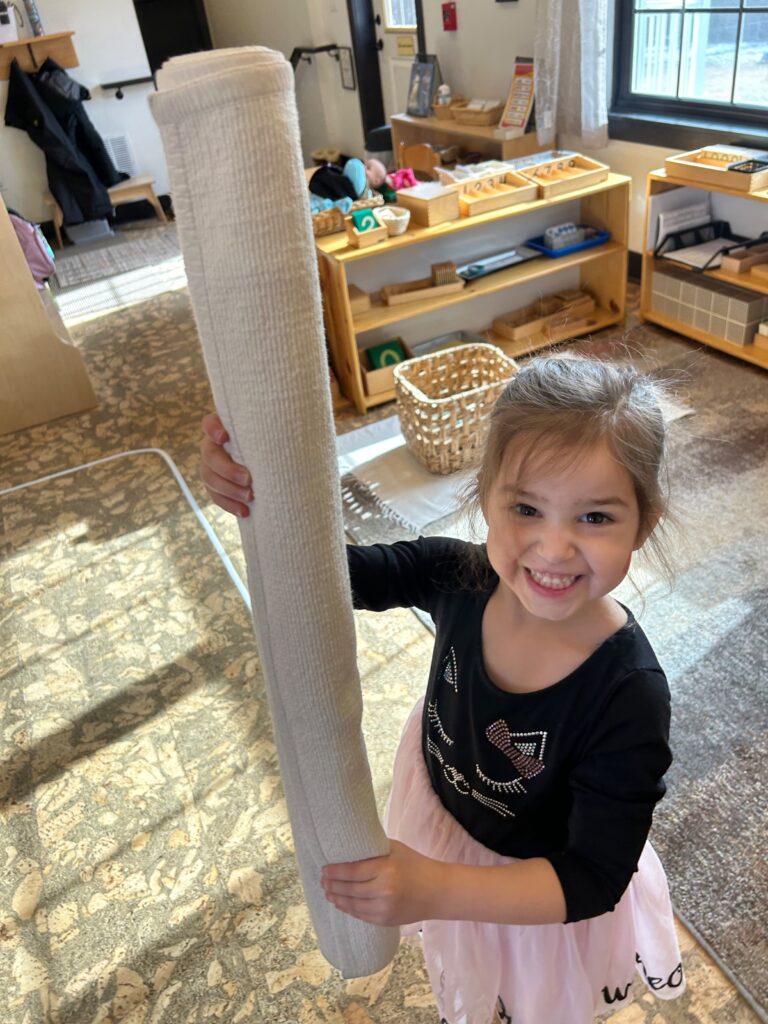
- Voluntary Actions: As children grow, they begin making intentional choices. When a child chooses which snack to prepare, which material to select from the shelf, or how to carry a heavy tray with two hands, they are actively exercising their will.
- Conscious Actions: Around age four and a half, motivation increasingly comes from within. The choices children make are guided by reason, foresight, and understanding.
The Role of the Prepared Environment
The will develops exclusively through lived experience. This means the child’s physical and social environment plays a central role.
Montessori environments are intentionally prepared to offer real choices paired with natural consequences. Freedom within clear, safe boundaries helps children learn how to act with purpose and reflect on their choices.
By offering age-appropriate choices (“Would you like to carry the tray or the working mat?” or “Would you like to walk by yourself or hold my hand?”), we provide manageable opportunities to exercise judgment. Every real choice strengthens the internal muscle of the will.
Balancing Impulse and Inhibition
Dr. Montessori identified two fundamental internal forces: impulse and inhibition. Young children are naturally driven by impulse—an intense curiosity to explore, touch, and move. However, healthy development requires learning how to regulate those impulses.
The will provides the necessary balance, moving the child from immediate reaction to conscious choice. In a prepared classroom, children build the capacity to pause and think: “I want to do this… but is it respectful to my environment and peers?”
This balance directly forms character. We do not seek passive compliance; we aim to help children build the internal strength to focus, overcome challenges, and act with integrity. Modern research often calls this “grit” or “executive function,” but Dr. Montessori recognized it over a century ago as the outcome of a well-developed will.
Obedience: A Natural Outcome
Traditional approaches to discipline often demand obedience early, sometimes before a child is developmentally capable of self-control. Montessori understood that true internal discipline is a choice—and a mature will must exist to support that choice.
She outlined three stages of obedience:
- The child cannot obey: They do not yet possess the physical control or cognitive skills to execute the command.
- The child can obey sometimes: As coordination grows, the child can follow directions, though not yet consistently.
- The child chooses to obey joyfully: They align their will with trusted adults out of mutual respect, affection, and understanding.
At this highest level, obedience is not about fear or external power; it is about social harmony and self-regulation. But to reach it, children must first be given the space to build their own will.
Why It Matters
Cultivating the will is not about raising compliant children. It is about supporting articulate, self-reliant individuals who understand their own capacities, make decisions thoughtfully, and contribute meaningfully to their community.
At Maravilla Montessori, we offer an environment where children grow into themselves with dignity, focus, and self-direction.
Curious to observe how self-directed learning builds confidence in our classrooms? We invite you to schedule a tour of our Waukesha campus today.